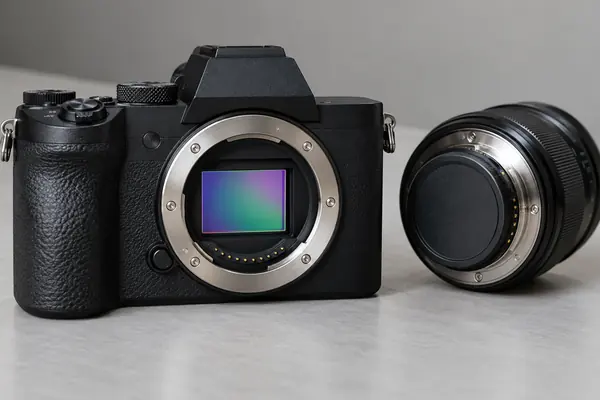

THE AIRY DISK
A point becomes a spot
Light through a round aperture forms a bright centre with fainter rings, the Airy disk. Its diameter is about 2.44 × wavelength × f-number.
Pick an apertureTHE PHYSICS OF SHARPNESS
Every lens blurs a little, even a perfect one.
Light spreads out as it passes through any opening. The smaller the aperture, the bigger the blurred spot each point of light becomes. At high f-numbers that spot can be several times wider than a sensor's pixels, so stopping down for depth of field costs fine detail.

2.44 × λ × N the size of the blur spot
THE SHORT ANSWER
Diffraction is not a lens fault.
It happens at every aperture, perfect or not.
THE AIRY DISK
Light through a round aperture forms a bright centre with fainter rings, the Airy disk. Its diameter is about 2.44 × wavelength × f-number.
Pick an apertureTHE TRADE-OFF
f-number drives depth of field and resolution in opposite directions. Stopping down deepens focus but enlarges the diffraction spot, so compromises have to be made.
How to chooseTHE SENSOR
The smallest spot a lens can make can quickly exceed the size of small pixels. Then the sensor's full resolution can no longer be used with good contrast.
See the numbersA QUICK APERTURE CHECK
Pick an f-number. The value is the Airy disk diameter for green light (520 nm); the bar shows how much diffraction blur that means.
Theoretical values for a perfect lens, from Edmund Optics' imaging notes. Real lenses also lose detail to aberrations and manufacturing tolerances.
TWO NUMBERS WORTH KNOWING
One figure on the size of the spot,
one on how much detail survives.
≈ 20µm
Diameter of the blur spot at f/16, green light
At f/16 the theoretical Airy disk for 520 nm light is 20.30 µm across, eight times the 2.54 µm it is at f/2. Real lenses can only do worse, never better.
AIRY DISK · EDMUND OPTICS
120lp/mm
Finest detail at f/16, at zero contrast
The cut-off for detail falls from 687 line pairs per millimetre at f/2.8 to 120 at f/16. Sensors generally need 10% contrast or more to record detail at all, so usable detail is lower still.
DIFFRACTION LIMIT · EDMUND OPTICS
OpenStax University Physics (Rice University) calls this limit an inescapable consequence of the wave nature of light: diffraction limits the resolution of any system with a lens or mirror, from eyes to telescopes.
FOUR THINGS TO WEIGH
There is no single best f-number. These points from optical engineering guides explain the balance.
It is the focal length divided by the effective aperture diameter. Higher numbers mean a smaller opening.
Raising the f-number by a factor of about 1.4 halves the aperture area and the light reaching the sensor.
A higher f-number deepens the depth of field but enlarges the diffraction spot. Optical guides say a compromise has to be made.
Up close, the working f-number rises: a lens at f/2.8 working at 0.5× magnification behaves like about f/4.2.
WHY PIXELS MATTER

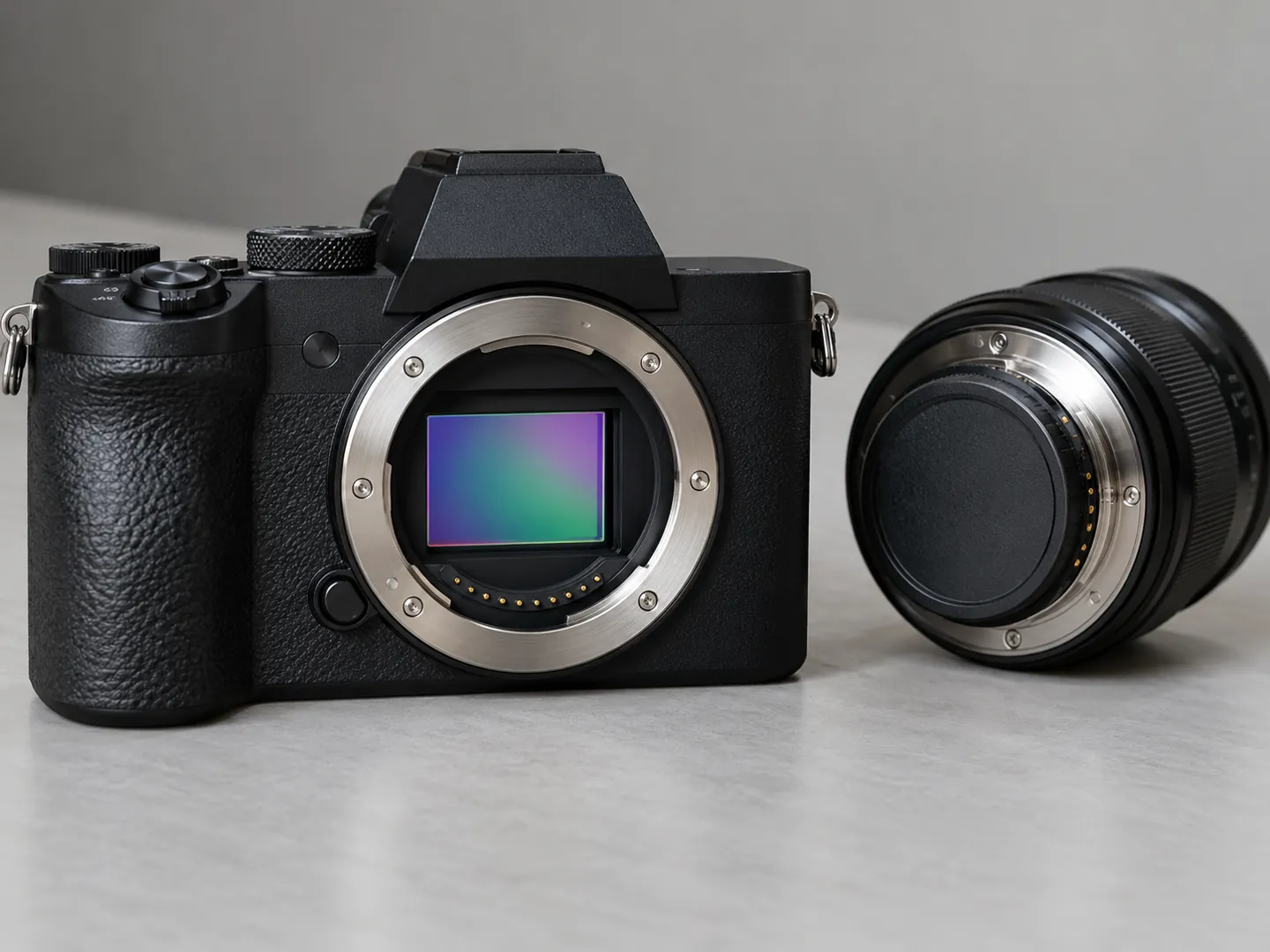
A sensor can resolve at most one line pair across two pixels, its Nyquist limit. Smaller pixels push that limit higher, which means the lens's diffraction spot overtakes the pixel size at a lower f-number.
Edmund Optics notes that diffraction becomes more of an issue as pixels continue to shrink, and that the theoretical spot size is only a starting point: lens design limits and manufacturing errors reduce real-world resolution further.
Questions
When light passes through any aperture it spreads, forming a bright central spot ringed by fainter circles called the Airy disk. The smaller the aperture, the larger the spot, which softens fine detail.
No. Diffraction sets an upper limit on every lens. Edmund Optics notes that a perfect lens, not limited by its design, will still be diffraction limited.
For green light at 520 nm, the theoretical Airy disk is about 10.15 µm across at f/8, compared with 3.55 µm at f/2.8 and 20.30 µm at f/16.
Each step multiplies the f-number by about 1.4, the square root of 2. That halves the aperture area, so each step lets in half as much light.
The working f-number rises with magnification. A lens set to f/2.8 at 0.5× magnification behaves like about f/4.2, so diffraction and light loss are greater than the ring suggests.
Sources
ABOUT THIS NAME
mirrorlessfullframecamera.com is part of the DoodleSale portfolio. It isn't in an auction right now, but you can ask about leasing it.